


Women are afraid of a political active life
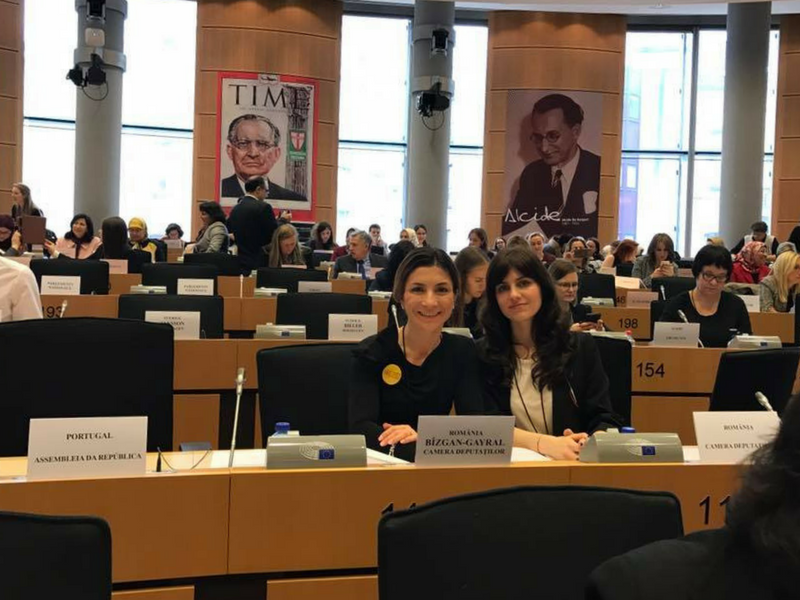
I am honored to stand here with you today and be able to address such crucial issues as women’s representation and their taking part in decision-making.
Both in the technocratic government and, now, in the Romanian Parliament, as well as in all the other local and central institutions I have interacted with, I can firmly say that women employees are the majority. Still, the top management is almost exclusively male.
In Romania, 80% of political science & public administration graduates are women. Still, we are one of the EU member states with the lowest percentages of women in politics, elected in the Parliament or appointed to ministry etc. There is no Roma or Nomad woman elected, nor women with disabilities or from other vulnerable groups.
I’m sure you are all familiar with similar statistics and have read most of the studies on the subject. I remember one specifically, where women in leading public & private institutions were asked to give reasons as to their avoidance of a political active life. The list was long, but the first and preferred answer was “I am afraid”.
Push-back from men, including sexual harassment – see the recent #metoo campaign – physical violence, taunting and bullying. Lack of sorority and a strong sense of competition with other women politicians. Excessive media attention on women’s physical attributes rather than their experiences and political platforms, on their clothes and make-up, on their personal relationships and private life rather than the laws they pass. Who would willingly and voluntarily stand for this?
So how do we break this chain?
A woman in politics can never be wrong – the standards set are much higher than those for their male colleagues. A woman in politics can never be ambitious – she will be an“Iron Lady”, bossy, a bitch. She can never complain, be emotional, irritated etc. – she’ll be hysterical.
In Romania, women politicians, including myself, are often rumored to be one politician or another’s mistresses and people often invent personal ties, simply because people cannot imagine that a woman can make it by herself without the help of an influential male.
Of course, there are many more reasons and explanations why women build a career far and away from this bureaucratic chaos: political campaigns are expensive, political parties are male dominated, the electoral laws are biased against independent candidates etc.
So how do we break this chain? I see 3 possible solutions:
Tackle violence – including harassment, hate speech, have a European compulsory directive, European funding addressing women’s political participation specifically.
Educate: we need gender sensitive schoolbooks, training for the teachers and parents, the editing of an EU manual with all the information you’d need to enter politics or join a political party.
Role-models, ambassadors, influencers – call it whatever you want, the important thing is for women to see other women succeed in politics. I personally invite you all to a future event to be hosted in Romania next year – details are still to be set – but what is important is for all these meetings and networks to be visible and close to countries with bigger delay than Belgium, France and other EU member states where we usually meet.
Quotas are a sensitive issue in Romania, ever since their prior pointless use by the former communist regime, but should you consider that we can help, I’d be very glad.
As to the representation of women in parliament and government there is progress but it is excruciatingly slow. At this rate, it will take 50 years to reach 50-50 parity. And I am not willing to wait. I trust I am not the only one
Thank you!